





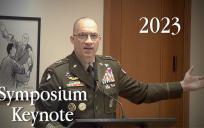
Record date:
U-505 Naval History Program: 5th Annual Fulfillment Ceremony
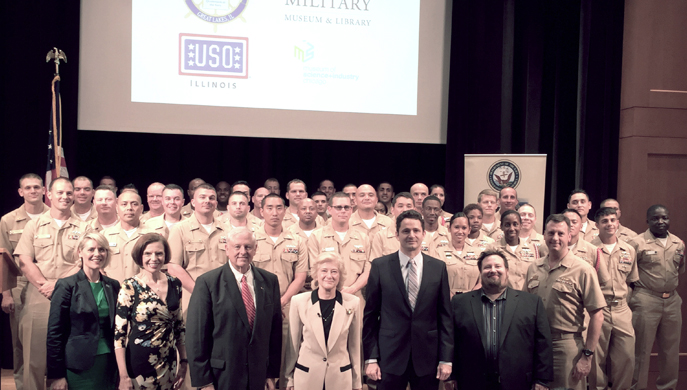
In cooperation with the Museum of Science and Industry and with the generous support of Tawani Foundation, the Museum & Library supports the training of Navy Chief Petty Officer (CPO) selectees by hosting and sponsoring activities related to the USO of Illinois' U-505 Naval History Program.
The first of its kind in the nation, created by the USO of Illinois, the program connects the American public with future U.S. Navy chief petty officers in a mutually beneficial partnership between the American public, military learning institutions and the naval population at the nation’s only Navy boot camp—Naval Station Great Lakes, just north of Chicago.
CPO selectees travel to MSI and the Pritzker Military Museum & Library for a day of training on the history and artifacts related to the U-505—the only German U-boat captured during World War II—and to conduct research on naval leadership. Now located in a 35,000-square-foot exhibit at MSI, the vessel is extremely relevant to the U.S. Navy experience and serves as a national war memorial for those who lost their lives in the two battles of the Atlantic during World Wars I and II. U.S. submariner veterans also join in the training to impart their knowledge and experience to the selectees, building connections between future Navy Chief Petty Officers and past generations.
Navy Chief Petty Officers serve as not only technical experts, but as exemplary leaders who possess high personal and professional standards. CPO selectees then volunteer at the U-505 Submarine exhibit for several days in early September, answering questions and engaging museum guests with various submarine-related artifacts. Museum guests have an opportunity to not only learn about the U.S. Navy’s heroic effort during World War II and how those actions changed history, but to also gain a greater awareness and appreciation of the men and women serving in uniform.



2015 U-505 Program Winning Essay
Analysis and Significance of the WWII German submarine U-505's Capture in the Battle of the Atlantic, By Chief Justin Jenkins, U.S. Navy
The U-505 was the United States first enemy vessel to he captured on the high seas since HMS Macedonian in the War of 1812.
The capture of the U-505 on June 4th, 1944 was realized because American Captain Daniel Gallery foresaw the possibility of capturing a U-boat after watching the laggard sinking of the U-515 on the 9th of April, 1944. German procedures were to surface their damaged submarines, thus allowing for the crew to escape prior to scuttling the boat. Captain Gallery thought that if his sailors could board the submarine during the scuttling process, they would be able to stop the flooding and "save" the boat from sinking. The dilemma was that it would be a dangerous operation to enter a sinking boat charged with explosives.
Utilizing intelligence from the captured U-515 German prisoners, Captain Gallery trained boarding parties to prevent incapacitated submarines (typically from depth charges) from being scuttled by locating and securing sea strainers and disarming scuttling charges. Because the Americans were prepared to quickly board the damaged U-505, her scuttling charges were not set. The Americans were fast to secure the sea strainer which prevented the sinking of the vessel.
With the capture of the U-505, the United States gained a functioning, four-rotor enigma machine which was used to encrypt and decipher secret codes. The intelligence was quickly transferred to Bletchley Park in England for decryption. It Is estimated that the decoding efforts preformed at the Bletchley facility reduced the war's duration by at least two years. The Allies used the intelligence to deploy "Hunter Killer" Task Groups to identified U-boat locations for engagement. They also maneuvered convoys away from sub-surface dangers.
When the U-505 was captured, she was secretly towed to a remote location in Bermuda. If the U-505 had been discovered by the Germans, it could have meant disaster for the D-Day landing at Normandy, just two days later. The Germans would have most assuredly changed their enigma code if they had thought it was compromised. While in Bermuda, analysts found two intact G7es acoustic homing torpedoes, which led to improvement of the "Foxer" anti-torpedo countermeasure system and refreshed tactics to protect Allied convoy escorts.
The U-505 was crucial to winning the Battle of the Atlantic, and the intelligence recovered directly finished the war. She is currently located at the Museum of Science and Industry in Chicago. She was refitted with many of the lost components by the original German manufacturer, and she is on display as a testament to German engineering as well as American tenacity and bravery.